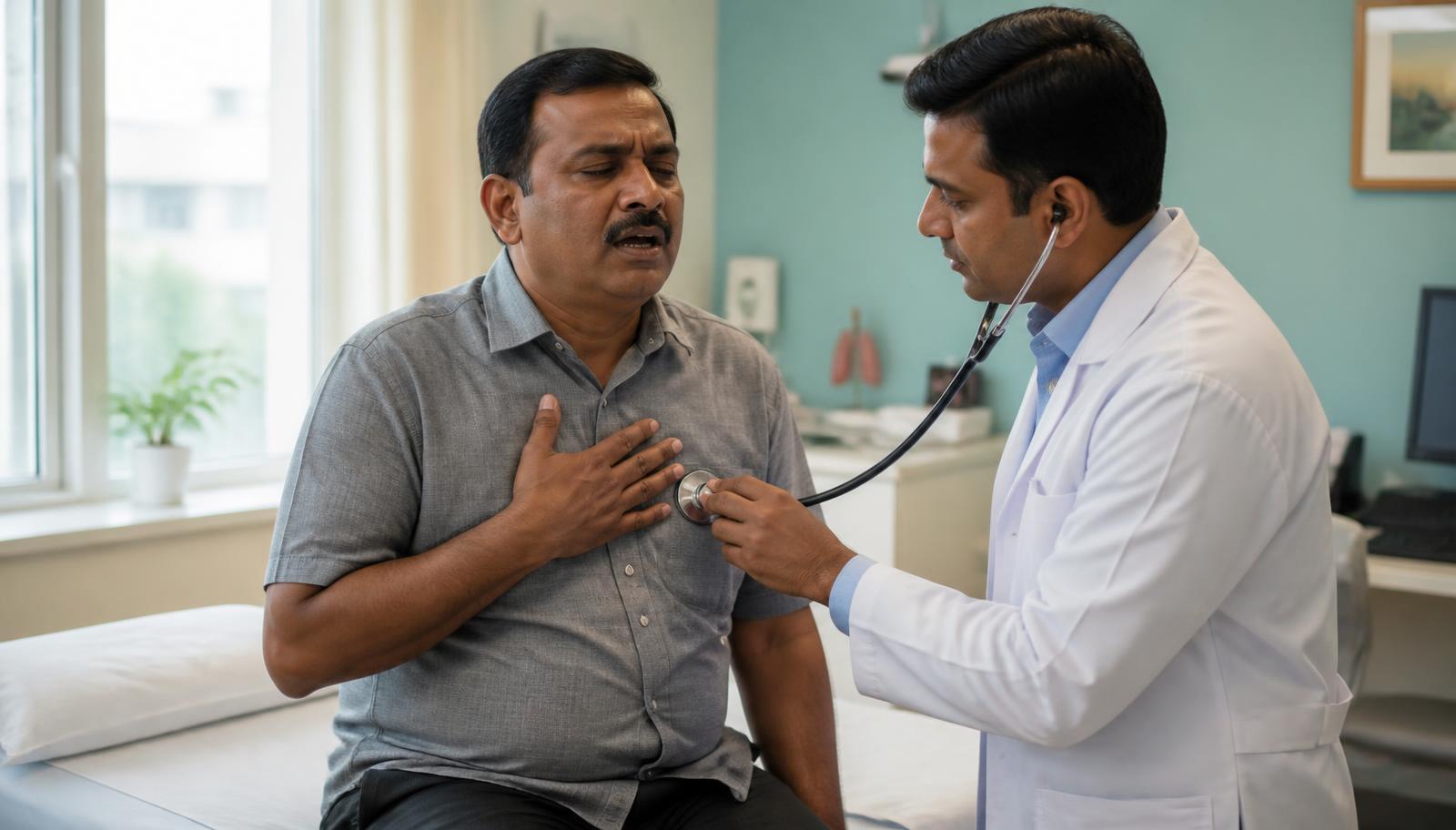
What "shortness of breath" actually means
Doctors call it dyspnoea — the uncomfortable awareness of your own breathing. Patients describe it very differently: "I run out of air", "my chest feels tight", "I can't take a deep breath", "I get tired climbing one floor". All of these are the same complaint, and all of them deserve an explanation rather than a cough syrup.
Breathlessness after climbing four floors quickly is normal. Breathlessness that is new, worsening, or out of proportion to the effort is not. That single distinction is the most useful thing in this article.
Red flags — when to go to an emergency room now
Do not wait for an OPD appointment if any of the following are present:
- Breathlessness that came on suddenly, within minutes to hours
- Chest pain or heaviness, especially spreading to the jaw or left arm
- Blue or grey lips, tongue or fingertips
- Oxygen saturation below 92% on a home pulse oximeter
- Coughing up blood
- Confusion, drowsiness, cold sweating or fainting
- Unable to complete a full sentence in one breath
- Swelling and pain in one calf with sudden breathlessness (possible clot)
Our Respiratory ICU in Bharuch runs 24×7 with ventilator and non-invasive ventilation support. In a genuine breathing emergency, travel time matters more than paperwork — come in, we register afterwards.
The 12 most common causes of shortness of breath
Lung causes
- Asthma — episodic breathlessness with wheeze and night cough, often triggered by dust, smoke or cold air. See our complete asthma guide.
- COPD / chronic bronchitis — slowly progressive breathlessness in smokers, biomass-fuel cooks and industrial workers, with morning cough and sputum.
- Chest infection or pneumonia — fever, cough, sharp chest pain and rapid breathing over a few days.
- Tuberculosis — weeks of cough, weight loss, evening fever and appetite loss. Read the TB symptoms and treatment guide.
- Interstitial lung disease (pulmonary fibrosis) — dry cough plus breathlessness that steadily worsens over months, with crackles on examination.
- Pleural effusion or pneumothorax — fluid or air around the lung, causing one-sided chest discomfort and rapid breathlessness.
- Pulmonary embolism (clot in the lung) — sudden breathlessness, fast heart rate, sometimes after surgery, long travel or prolonged bed rest. A medical emergency.
- Post-COVID lung changes — reduced exercise tolerance and breathlessness that lingers for weeks. See post-COVID lung recovery.
Non-lung causes we see just as often
- Heart failure or valve disease — breathlessness lying flat, night-time waking gasping, ankle swelling.
- Anaemia — very common in Indian women; fatigue, palpitations and breathlessness on mild effort with a normal chest examination.
- Obesity, deconditioning and untreated sleep apnoea — daytime sleepiness and loud snoring point to obstructive sleep apnoea.
- Anxiety and panic — air hunger, sighing respiration, tingling fingers, normal oxygen levels. A diagnosis made only after ruling out the rest.
Same-day spirometry, chest X-ray, ECG and oxygen assessment at Samarth Chest Hospital, Bharuch — with the report explained to you on the same visit.
Reading your own pattern — a quick self-check
- Comes and goes, with wheeze → think asthma or allergy
- Worse flat, better on two pillows, ankles swollen → think heart
- Slowly worse over years in a smoker → think COPD
- Weeks of cough, fever, weight loss → think infection or TB
- Sudden, one-sided, with sharp pain → emergency, think clot, air leak or fluid
- At rest but fine while walking, with tingling hands → think anxiety, after tests are clear
How breathlessness is investigated in Bharuch
You do not need every test. A pulmonologist chooses from a short, logical list:
- Pulse oximetry at rest and after walking — the fastest objective clue
- Chest X-ray — infection, fluid, collapse, heart size
- Spirometry / PFT — separates asthma from COPD and grades severity
- ECG and cardio-respiratory workup — rules out cardiac causes
- Blood tests — haemoglobin, thyroid, kidney function, inflammatory markers
- 6-minute walk test — measures real-world capacity and oxygen drop
- Sleep study where snoring and daytime sleepiness are present
- CT chest or bronchoscopy when imaging or sputum results are unclear
In most patients, the cause is clear after the first four of these — often within a single visit.
Treatment: what actually improves breathing
Treatment follows the cause, not the symptom. Broadly:
- Airway disease — the correct inhaler, at the correct dose, with the correct technique. Technique is checked at every visit.
- Infection or TB — targeted antibiotics or the full anti-TB course, completed to the last day.
- Heart or anaemia — cardiology care, iron replacement, salt and fluid management.
- Sleep apnoea — CPAP therapy with pressure titration and weight reduction.
- Everyone — pulmonary rehabilitation, breathing exercises, flu and pneumococcal vaccination, and complete tobacco cessation.
Simple things that help while you wait for your appointment
- Use the pursed-lip breathing technique: inhale through the nose for 2 counts, exhale gently through pursed lips for 4
- Sit leaning slightly forward with forearms on your knees — it eases the work of breathing
- Avoid smoke, incense, mosquito coils and dusty rooms; ventilate the kitchen
- Keep a short diary: when it happens, what you were doing, how long it lasted
- Note your oximeter reading at rest and after walking 6 minutes — bring it with you
- Do not self-start steroids or antibiotics; they can mask a serious diagnosis
The bottom line
Breathlessness is a signal, not a diagnosis. Almost every cause on this list is either treatable or controllable — but only after it is correctly named. If your breathing has changed over the last few weeks, get a chest evaluation rather than waiting for it to settle on its own. Dr. Saurabh Bhatt and the team at Samarth Chest Hospital & ICU, Bharuch, see this complaint every single day.
Frequently Asked Questions
What is the most common cause of shortness of breath?
In adults, the four commonest causes are asthma, COPD, heart failure and anaemia. Obesity, deconditioning and anxiety are also very frequent, and more than one cause often exists in the same patient.
When is breathlessness an emergency?
Go to an emergency room immediately if breathlessness is sudden and severe, comes with chest pain, blue lips or fingertips, confusion, fainting, coughing blood, or if you cannot complete a sentence in one breath.
Can anxiety alone cause shortness of breath?
Yes. Anxiety and panic attacks cause rapid shallow breathing, air hunger and tingling in the hands or around the mouth. But anxiety should only be diagnosed after heart and lung causes are ruled out with basic tests.
Which tests are done for breathlessness?
A typical workup includes oxygen saturation, chest X-ray, ECG, complete blood count, spirometry (PFT) and, where needed, a 6-minute walk test, 2D echo or CT chest. Most of these are available same-day at our Bharuch centre.
Why do I feel breathless only when lying down?
Breathlessness that worsens flat and improves on two pillows (orthopnoea) suggests heart failure or fluid overload, and sometimes severe COPD or obesity. It should always be evaluated.
Can breathlessness be cured?
In most cases yes, or it can be greatly improved. Asthma, anaemia, infections and heart failure respond well to treatment; COPD and fibrosis can be stabilised with inhalers, oxygen and pulmonary rehabilitation.